About the Nelson Institute
Who We Are
The Nelson Institute is one of New Zealand’s oldest community organisations, founded in 1841 to spark learning, discussion, and curiosity in a growing settlement.
What began as a small group of settlers committed to the “diffusion of knowledge” has grown into a long-running tradition of talks, publications, and community engagement in Nelson.
Today, the Institute continues to support thoughtful conversation across arts, science, history, and public life — always with the aim of making knowledge accessible to everyone.
Our Origins
According to Cyprian Brereton’s History of the Nelson Institute, the first meeting of what became the Nelson Institute took place on board the Whitby somewhere in the Atlantic on 17 May 1841. The Whitby was one of three ships sent out from Gravesend by the New Zealand Company to establish the new settlement at Nelson. Captain Arthur Wakefield led the expedition.
Wakefield recorded in his diary that a meeting was held with all the officers present. Its purpose was to establish an institution, initially called The Nelson Literary and Scientific Institution, with the aim of spreading general knowledge through an extensive library and encouraging scientific research.
Once in Nelson, a group of high-minded professional gentlemen — surveyors, businessmen, and doctors — continued the effort. Many were prominent early settlers, with Alfred Domett being among the most notable. Domett was a talented and versatile figure: poet, lawyer, newspaper editor, politician, and later the colony’s fourth Premier (1862–63). During his short tenure as Premier he oversaw the important decision to move the capital from Auckland to Wellington.
The founders held a clear vision of a civic centre devoted to the pursuit and sharing of knowledge. Because of their own education and privilege, they saw value in giving ordinary settlers — most of whom had little or no formal education — opportunities to learn. Motivated by a strong belief in the democratization of knowledge, they opened Nelson’s first library and reading room on 27 September 1842.
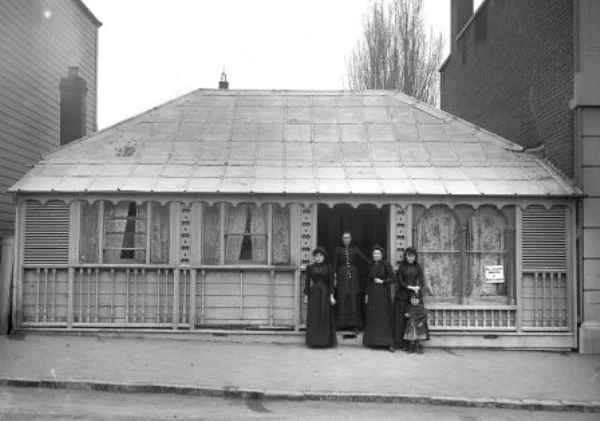
The original premises of the Nelson Institute, near the top of Trafalgar Street. Later, at the time of this photograph, it was occupied by a dressmaker.
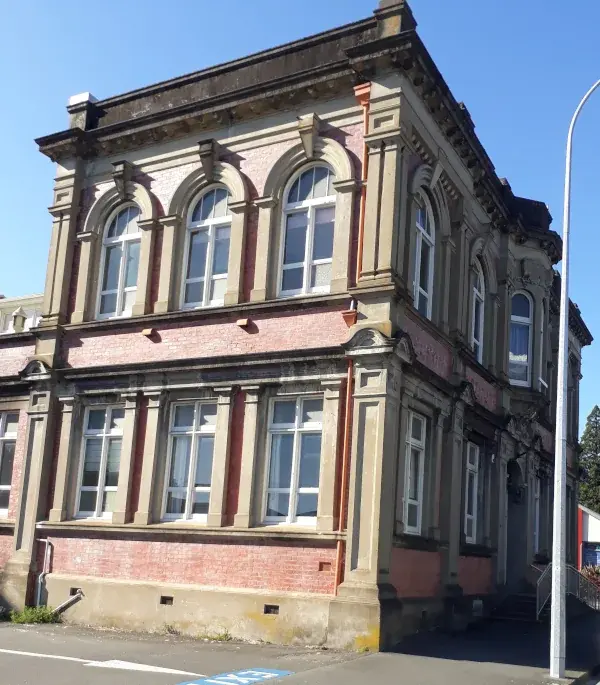
309 Hardy Street, home of the Nelson Institute, library and Museum from 1911 to 1970s. The building is currently out of use on account of earthquake risk.
Building a Community Institution
As Nelson grew, so did the Institute’s role in public life. Its rooms became a centre for reading, study, and public lectures. Over time, these talks and discussions became a defining feature — a space where ideas could be explored, challenged, and shared.
Although the role of libraries and museums evolved, the Institute remained committed to fostering learning and curiosity in the community.
The Institute Through Time
A simple timeline helps tell our story:
- 1841 – Founding meeting held aboard the Whitby.
- 1842 – First library and reading room open in Nelson.
- Late 1800s – Institute becomes a hub for public lectures, civic discussion, and cultural learning.
- 1907 – Incorporated by Act of Parliament.
- 20th Century – Talks and community events continue as core activities.
- Today – The Institute hosts regular public talks and publishes The Nelson Institute Review.
What We Do Today
The Institute’s work remains focused on encouraging learning and conversation in Nelson.
Talks & Events
We host regular talks and discussions on topics that inspire curiosity — from local history and environment to culture, science, and public affairs.
The Nelson Institute Review
Our Review publishes essays, reflections, and articles relevant to Nelson and the wider world.
It continues the Institute’s long tradition of sharing ideas in an accessible way.
Membership
Membership is open to anyone who enjoys ideas, discussion, and lifelong learning.
Members receive updates about upcoming talks and the latest Review.
Contact
If you’d like to learn more, attend an event, or contact the committee, you can reach us here: